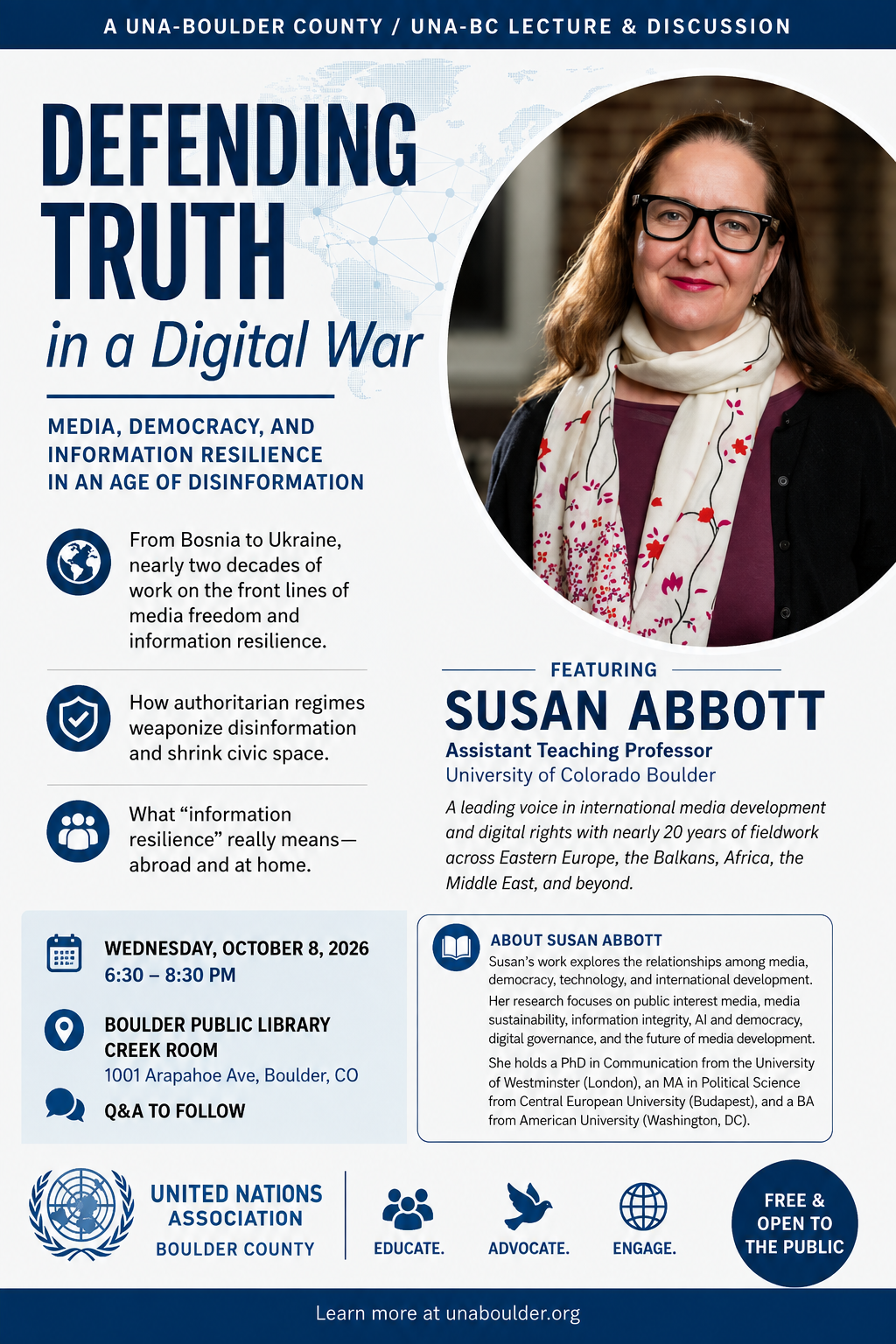
When governments, corporations and technology platforms shape our information, how do we protect responsible journalism without suppressing political criticism? University of Colorado’s Professor Susan Abbott’s talk on information resilience raises questions about who controls the news, who pays for independent reporting and who gets to decide what the public should believe.
At a recent United Nations Association Rockies discussion, Professor Susan Abbott explored the growing challenges facing independent journalism, democracy and trustworthy information. Drawing on her international work in media development and information integrity, Abbott described an information environment transformed by technology, weakened funding models and the growing difficulty of distinguishing credible information from manipulation.
One of her central arguments was straightforward: “The best anecdotes to bad information really is good information.”
But producing that good information requires more than skilled journalists. It requires institutions that can operate independently, sustainable funding, public access to credible reporting and the freedom to scrutinize those in power.
That raises a difficult question: who watches the institutions that claim to protect the truth?
The tension between accountability and freedom
Journalism needs standards. Claims should be verified, sources examined, errors corrected and conflicts of interest disclosed. Yet the institutions that enforce those standards can themselves be influenced by political or commercial interests.
When does regulating misinformation become an attempt to regulate political criticism? Who decides whether a story is irresponsible, misleading or simply inconvenient to those in power?
These questions sit at the heart of the debate between self-regulation and co-regulation.
Self-regulation allows journalists and media organizations to develop their own professional codes, complaints procedures and ethical standards. Co-regulation introduces a formal legal framework alongside industry standards. Both approaches can offer safeguards, but both raise questions about independence, enforcement and who ultimately controls the rules.
Abbott did not prescribe a particular regulatory model in the discussion. Her broader emphasis on independent institutions, public accountability and the need to adapt to changing threats gives us a framework for examining the dilemma.
The challenge is to hold journalism accountable without giving governments or other powerful actors an unrestricted ability to decide which criticism is permissible.
When independent media become financially dependent
Abbott highlighted the economics behind independent journalism. Different funding models offer different forms of support, but each creates its own vulnerabilities.
As she explained:
“Government funds, advertising, philanthropy, subscriptions, and aid each bring different incentives. And these are important, but they also bring vulnerabilities.”
This is a fundamental problem for journalism as a public good. Investigative reporting can uncover corruption, expose failures in public services and provide communities with information they need to make decisions. Yet its benefits are widely shared, while the cost of producing it falls on particular news organizations.
Subscriptions can support editorial independence but restrict access to those who cannot afford them. Advertising can reward reach rather than public value. Philanthropy and international aid can sustain reporting, but funding priorities can shift. Government support can preserve public-service journalism, while also creating opportunities for political pressure.
Abbott pointed to the effects of funding withdrawals on information ecosystems, including in the Philippines. She also discussed the difficulties of financing media in Hungary, where independent investigative outlets continued operating through a period of political pressure, despite severe financial challenges.
Her point was not simply that more money is needed. The media-development challenge, she said, includes understanding “market power and institutional design” and finding new ways to finance independent media and civil society.
The question is how to fund journalism that serves the public without making its survival dependent on pleasing whoever pays the bills.
Corporate ownership and the future of independent voices
Financial vulnerability becomes more consequential when media ownership is concentrated.
A newsroom may retain its name and publish stories while its editorial priorities are shaped by owners, advertisers, political relationships or commercial pressures. Control does not always require direct censorship. It can operate through decisions about which investigations receive resources, which editors are appointed and which subjects are quietly avoided.
Independent journalists and citizen reporters can challenge established media narratives, but they face their own difficulties: limited resources, uneven verification practices, uncertain revenue and dependence on digital platforms for audience reach.
The result is a complicated landscape. Traditional institutions are not automatically trustworthy, and independent voices are not automatically reliable. What matters is whether their reporting can be examined, challenged and corrected—and whether journalists have the freedom and resources to investigate powerful interests.
Abbott’s account of investigative journalism in Hungary offered a concrete example of why independent reporting matters. She described digital investigative outlets that continued operating through a difficult political period and preserved records that may prove important in understanding what happened.
Such journalism can provide a record that outlasts the political circumstances in which it was produced.
Can fact-checkers themselves be captured?
Fact-checking has become an important response to misleading claims, manipulated media and AI-generated misinformation. But fact-checkers are institutions too, and they are not beyond scrutiny.
An organization can be influenced by its funders, owners, political environment or editorial assumptions. Capture does not necessarily mean that a fact-checker fabricates evidence. It can also occur through the selection of claims to investigate, the omission of inconvenient subjects or the inconsistent application of standards.
Abbott’s talk emphasized the importance of tracing claims to their origins. In her words:
“Not only can AI hallucinate and make up stuff, but a lot of sources can just be bad.”
That observation applies beyond AI. A claim may be repeated by multiple outlets without any of them independently verifying it. A fact-check may accurately assess one narrow statement while leaving a misleading wider context unexamined.
Readers should therefore be able to inspect original evidence, understand a fact-checker's methodology, see relevant funding disclosures and identify how corrections are handled. Agreement with a conclusion should not be a substitute for examining the process that produced it.
The deeper question is whether accountability mechanisms can remain independent of the institutions they oversee.
Openness, development and political criticism
During the audience discussion, I raised a challenging comparison from personal experience: Papua New Guinea, where newspapers were described as consistently critical of government, versus environments in the Gulf Cooperation Council countries and China, where political criticism is more constrained and public narratives may emphasize economic development and national progress.
The question was whether openness is always the best approach for rapidly developing countries, particularly when persistent criticism can create negative public sentiment and political instability.
Abbott acknowledged the complexity of the issue. She connected the discussion to debates about technology, political power and the different models societies may pursue. But she also made her own position clear:
“I think we can fight for openness and democracy and values and human rights.”
She continued by recognizing that such an approach involves:
“Messiness, deliberation, and other factors that I don't think that we necessarily have the thinking at the moment completely figured out.”
That is an important distinction. The audience's comparison was not a comprehensive assessment of the media systems of Papua New Guinea, the Gulf or China, and those places should not be treated as interchangeable. The discussion nevertheless exposed a genuine tension: how should societies balance the benefits of open criticism against the desire for stability, economic confidence and a constructive national narrative?
The difficulty is that the power to define “responsible” criticism often rests with the institutions that criticism is supposed to scrutinize. Limits introduced in the name of social cohesion or development can also make it harder to expose corruption, policy failures or abuses of power.
The question is not whether every critical story is accurate or fair. It is whether journalists can investigate the powerful and publish evidence that challenges official accounts.
Who watches the watchers?
Abbott's talk does not offer a simple institutional formula for resolving these tensions. Instead, it points toward the importance of independent voices, credible information, accountable institutions and research into how information ecosystems function.
The future of journalism will depend in part on whether societies can develop sustainable funding models, protect editorial independence and ensure that fact-checking and regulation remain open to scrutiny themselves.
No single institution should have an unquestionable monopoly on truth. But a system in which every claim is judged only by personal preference is equally vulnerable to manipulation.
The goal is not to eliminate disagreement. It is to preserve the conditions in which disagreements can be investigated, evidence tested and public officials held to account.
How can we build a system in which journalism is responsible without being subordinate—and in which the institutions that define trustworthy information are themselves accountable?
That is one of the central challenges in defending truth we face in this new media era.