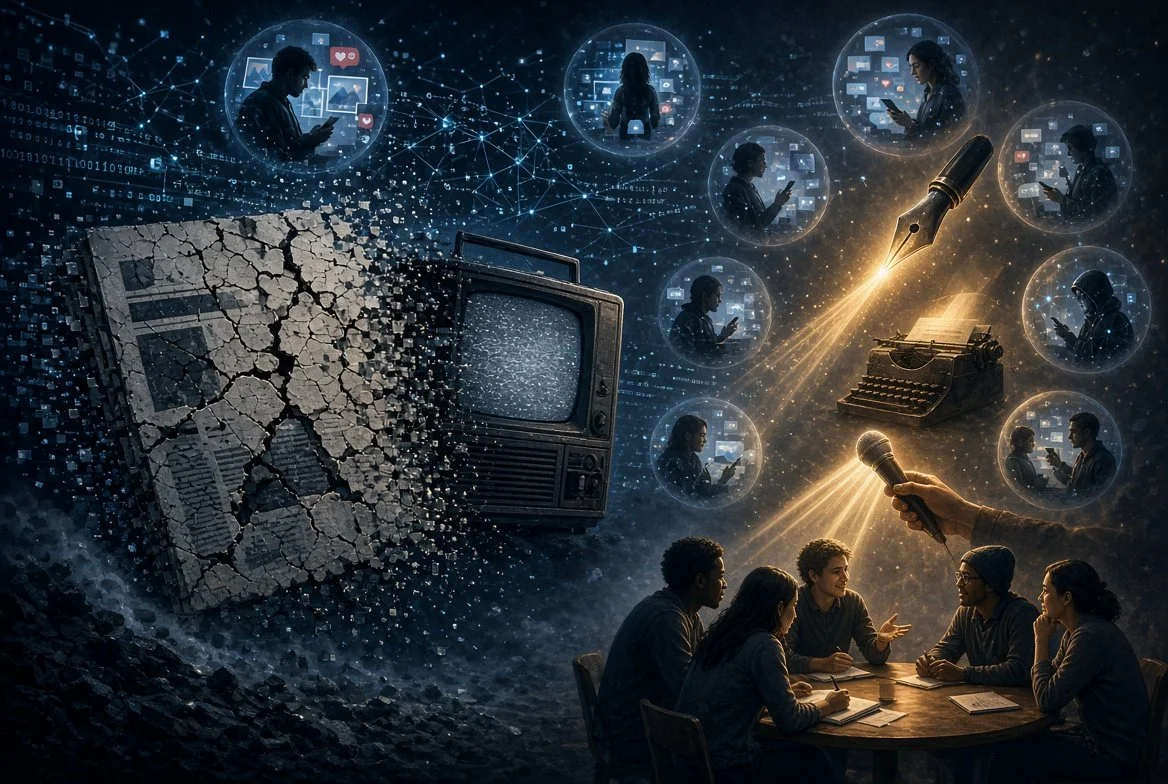
As audiences move from newspapers and broadcasters to personalized feeds, influencers and AI assistants, are we losing the shared institutions that once helped us understand the world? Professor Susan Abbott argues that information resilience requires more than better technology: it requires independent journalism, human connection and the ability to examine evidence.
What happens when people no longer share the same sources of information—or even the same assumptions about which sources deserve to be trusted?
That question ran through Professor Susan Abbott's discussion of media, democracy and information resilience at a United Nations Association Boulder County event. Drawing on her international work in media development and information integrity, Abbott explored how AI, social platforms, funding pressures and changing news habits are reshaping the information environment.
Her talk raised a troubling possibility: the problem may not simply be that false information is spreading faster. We may also be losing the institutions and shared experiences through which people once encountered, evaluated and debated the same news.
Are we approaching the end of institutional media?
Newspapers, radio and television have never been perfectly neutral. Ownership, political relationships, editorial judgment and commercial incentives have always influenced what gets reported.
Nevertheless, established newsrooms have traditionally offered identifiable organizations, editors, professional processes and mechanisms for correcting mistakes. They have also provided a common reference point: people could disagree about a report while at least knowing which report they were discussing.
That role is changing.
Abbott described how the students she teaches increasingly encounter news through social platforms rather than traditional broadcasters. Referring to research on changing news habits, she observed that many of her students get information through Snapchat, Instagram and TikTok.
As she put it:
“So there's a trend that you have your feeds open, you're looking at the feeds. And if the news pops up, you'll look at it.”
This is a different relationship with news. Instead of deliberately turning to a publication or broadcast, people may encounter stories incidentally, selected and presented within an environment designed around their interests and habits.
The shift does not mean institutional journalism has disappeared, nor that every young person consumes news in the same way. It does, however, raise questions about how audiences discover original reporting, recognize its source and distinguish journalism from commentary, advertising and influencer content.
If traditional news organizations lose their role as shared reference points, what replaces them?
The rise of self-curated reality
Social platforms and AI tools make it easier for people to find information tailored to their interests. They can discover independent journalists, hear directly from people affected by events and access perspectives that established media may overlook.
But personalized information also creates a risk. Recommendation systems can repeatedly expose people to similar viewpoints, while personal choices may reinforce the effect. A feed can feel comprehensive without showing the evidence or perspectives most likely to challenge a person's assumptions.
The result may be a collection of self-curated information environments, each with its own trusted personalities, favored sources and explanations of events.
Abbott's work in the Sahel illustrated another dimension of the problem. She described people operating from outside the countries they were discussing, using online platforms to build audiences and monetize negative or toxic information.
She noted:
“Once you put stuff out there, it's very hard to take back.”
This matters because information does not remain neatly within national borders. Content produced elsewhere can influence local debates, while people who encounter it may have little insight into who created it, why it was published or how it is being financed.
The challenge is not simply to identify individual falsehoods. It is to understand the wider information ecosystem: who produces content, how it travels, what incentives sustain it and which communities are most affected.
AI: more information, less certainty?
Generative AI introduces another complication. It can help people summarize complex subjects, translate reporting, find sources and explore unfamiliar topics. It can also produce convincing answers that contain errors, omit essential context or cite sources that do not support the claim.
Abbott urged people to trace claims back to their sources and practice verification, especially when AI is involved.
Her advice was direct:
“We all need to learn to practice verification, check for consequential AI answers.”
That is more than a technical recommendation. It is a warning against outsourcing judgment.
In the audience discussion, Abbott reflected on students using AI to answer questions and write papers, and on the wider need to reconsider education, dialogue and classroom experiences. She stressed the importance of maintaining human agency as these tools develop.
She also described a troubling feedback loop in the workplace: applicants using AI to generate résumés and cover letters, while employers use automated systems to screen them. Grant applicants may use AI to draft applications that are then assessed by another AI system.
At what point, Abbott asked in effect, does a human being meaningfully exercise judgment?
The same concern applies to news. If content is generated by AI, selected by algorithms and summarized by another AI system, how easily can a reader identify the original evidence and the people responsible for a claim?
The technology may make information more accessible. But accessibility is not the same as understanding, and a confident answer is not the same as a verified one.
What information institutions would we want in a crisis?
One of the most revealing moments in Abbott's talk came when she asked:
“What information institutions would you want in a crisis and what are we doing to sustain them?”
The question invites us to think beyond our everyday media preferences. Imagine a public emergency, a conflict or a major disruption to essential services. Which sources would we need to understand what is happening? Would we want only a government announcement, a social media feed or a single news organization?
In the discussion, Abbott argued for multiple sources:
“The first one is to want multiple institutions, not just one.”
She also emphasized the value of both national and local institutions, including government and non-government sources. Local reporting can reveal conditions that national coverage misses; public institutions can provide essential information; independent journalism can investigate official claims.
This is a practical argument for pluralism. A resilient information system should not depend entirely on one institution, one platform or one funding source.
Abbott also asked what we are doing to sustain these institutions before a crisis occurs. Independent journalism cannot simply be summoned when it is urgently needed. Reporting requires people, resources, relationships, expertise and time.
The economic challenges discussed in her talk are therefore directly connected to public resilience. When funding disappears and independent reporting shrinks, communities may lose not only today's news but also the capacity to investigate tomorrow's emergency.
Is there an antidote to algorithmic echo chambers?
Abbott offered a set of practical approaches to building healthier information ecosystems. They included supporting original journalism, pausing before sharing, following claims to their sources, strengthening digital habits, making room for conversation, sustaining independent institutions, encouraging platform accountability and continuing research.
Her central point was that good information requires investment:
“We can't counter the bad information if we don't have resources, paying journalists, academics, and others to be able to do what they do.”
This is a crucial correction to the idea that misinformation can be solved through individual vigilance alone. People need the skills to evaluate information, but they also need access to credible reporting and institutions capable of producing it.
Abbott also emphasized the value of in-person conversation. She described herself as encouraged by deliberative democracy, citizen assemblies and other events that allow people to move beyond their online personas.
Her response to digital negativity was to call for more “analog” interaction: people meeting, discussing and listening to one another in real life.
That does not mean face-to-face conversations are automatically accurate or free from bias. It means that information resilience involves social relationships as well as technology. People need opportunities to ask questions, reconsider assumptions and engage with others who do not share their views.
Staying human in a digitally saturated world
Abbott's concerns extended beyond news consumption to the broader effects of digital technology on education, attention and everyday life.
She argued for maintaining human agency and developing healthier relationships with technology. She also raised the importance of human-centered design and creating lives in which not everything is digital.
In her words:
“We need to figure out ways to coexist with the technology.”
Her discussion of education was particularly important. If students increasingly rely on AI to produce answers, what happens to the process of reading, questioning, experimenting and learning to think independently?
Abbott suggested that people may need to make time to disconnect, read, create and simply be bored. These may sound like small interventions in a global information crisis, but they point toward a broader principle: people need the time and mental space to exercise judgment rather than respond continually to the next notification, post or generated answer.
A healthy information environment is not only one in which accurate material is available. It is one in which people have the ability and opportunity to evaluate it.
A shared public reality without a single authority
There is no easy solution to the decline of institutional trust. Traditional media can fail. Independent voices can mislead. Governments, corporations, donors and platforms can all influence information. AI can help people examine evidence, but it can also obscure the origins of claims.
The answer is unlikely to be a new institution that everyone must trust. It is more likely to involve a combination of independent journalism, transparent verification, diverse sources, accountable platforms, education and spaces for meaningful public discussion.
The goal is not universal agreement. People will continue to disagree about values, policies and interpretations. But public debate becomes harder when people cannot establish what happened, identify credible evidence or agree on how competing claims should be tested.
Abbott's talk returned repeatedly to the importance of supporting independent voices, sustaining institutions and equipping communities to withstand misleading information.
The question she leaves us with is larger than whether we can spot a fake headline or configure a social media feed.
If institutional media no longer provide a shared point of reference, and our personalized feeds increasingly shape the reality we see, can we build an antidote to algorithmic echo chambers?
Perhaps the answer begins not with finding one perfect source of truth, but with ensuring that no single source has to be trusted blindly—and that independent evidence, human judgment and public discussion remain possible.